
Our work / Supporting Caseworkers in Transition
Supporting Caseworkers in Transition

When a Member of Congress retires, moves on, or loses an election, their caseworkers face a hard few months: closing out open cases, shutting down an office, and figuring out what comes next. CSI works to document how these transitions play out, develop custom resources to help teams manage transitions, and help caseworkers navigate next steps in their careers.
FOCUS
Champion · Research
FOR
Caseworkers in offices whose Members are leaving
TIMELINE
Fall 2026 to March 2027
What we’re doing
-

Job Hunting for Caseworkers
Guide to the job search for caseworkers: job board list, tips on framing casework for new fields, and advice from former caseworkers.
-

Editable Casework Transition Spreadsheet
Downloadable automated spreadsheet for offices transitioning cases to colleagues to auto-draft emails and keep track of which cases are completed.
-

Casework Transition Group
Join our group for caseworkers transitioning to new roles. Participants can access a private Signal/WhatsApp group to share casework-related jobs, career coaching sessions, and other resources.
-
Caseload Transition Calculator
Interactive tool for casework teams to manage the timing and volume of casework handoffs in a transition.
-

Closing a Casework Operation
Guide to closing a casework operation for caseworkers and casework managers from POPVOX Foundation’s Casework Navigator program
What we’re learning
We interviewed caseworkers in departing offices in both the House and Senate about how they manage an election-year transition. Their answer surprised us: the real transition isn’t a single handoff in January. It is a months-long redistribution of constituent demand across an entire delegation. As outgoing offices wind down in the fall, that demand flows to the offices that are staying, often across chambers, and the strain lands unevenly on a few casework teams.
Key takeaways
The surge starts in October. Outgoing offices usually stop opening new cases in early to mid-October and refer constituents to offices that are staying.
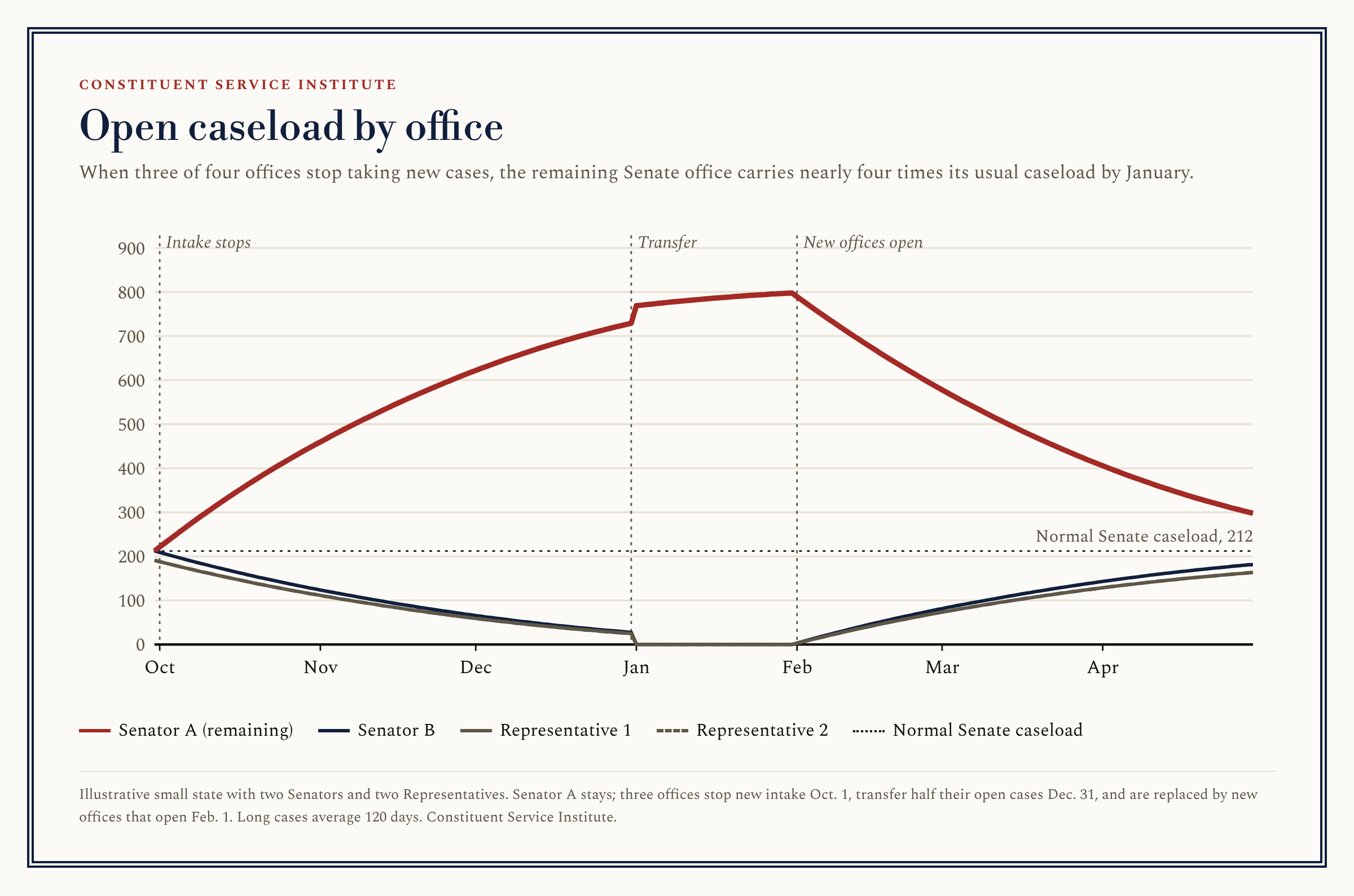
One office can end up carrying a whole state. In our model of a small state where three of four Members turn over, the remaining Senate office’s open caseload nearly quadruples by January.
The strain lasts more than six months. Only a natural disaster produces a comparable surge, but unlike a disaster, an election can be planned for.
Planning tools don’t exist yet. Current CRMs available in the House and Senate only provide backward-facing caseload management tools — a potential area for innovation would be adding new tools to help casework managers analyze their data to predict trends and impacts of changing caseload times.
CRM data transfers are less prominent than previously discussed. Many casework teams deliberately aim to close out all cases before closing the office to avoid potentially messy handoffs if the incoming office does not take transferred cases and the constituent is left in limbo.
No one sees across both chambers. House offices wind down while Senate offices absorb the demand, and no institution currently has visibility into both.
Read more at the CSI Substack.
How can we help?
Got a question or a resource you’d like to see here? Come chat!