
Hiring Great Caseworkers
Who this guide is for
This guide is for transition teams in Member and Member-elect offices in the process of hiring constituent services staff for roles they may not be personally familiar with. This guide covers what constituent services are, skills and traits that make a good caseworker, sample job descriptions (with average salary bands), and sample interview questions to help identify great members of a startup casework team.
JUMP TO…

What makes a great caseworker?*
Your constituent service team is the SEAL team of constituent engagement. They take the toughest calls, from constituents in the most difficult circumstances, and they carry out some of the most important work for defining your Member’s reputation as trustworthy, competent, and dedicated to representing all constituents. Hire for organization, patience and grace with the public, creative problem-solving, and resilience. No single background makes a great caseworker — prioritize motivated problem-solvers who have worked directly with the public.
*A note on job titles
Congressional offices use a wide variety of titles to describe the core functionality of constituent services/legislative casework — much more so than other roles. You may see this job referred to/advertised as any combination of Caseworker, Constituent Services Representative, Constituent Advocate, Constituent Liaison, District aide and caseworker, [population] liaison (e.g. Veterans Liaison, Immigration Liaison, Northeast, etc), and more.
In this guide, we’ll refer to “caseworkers” for brevity.
The core job
Constituents usually call your office after they've run out of other options. Their VA benefits stopped without warning. They're stuck in a bureaucratic snafu with Social Security. They've sent the IRS the same document three times and keep getting asked for it again. Their kid's passport expired, and the school trip leaves tomorrow. A loved one is overseas in a country where fighting just broke out, and they need to get home now.
Caseworkers are dedicated professional staff who take these calls, act as the liaison between the constituent and the agency — or agencies — involved, and work the problem until it's resolved.
Caseworkers also:
Navigate. Many constituents need help the federal government can't provide. Caseworkers connect them to state, local, and community resources.
Inform policy and oversight. Caseworkers see firsthand where programs break down. The best ones translate constituent experience into input your legislative team can use, and stories your comms team can use to tell the story of why it’s important and how your team is helping.
Pinch-hit. A Constituent Service Institute survey of current caseworkers found that many also play important roles supporting other vital functions of the district or state office.
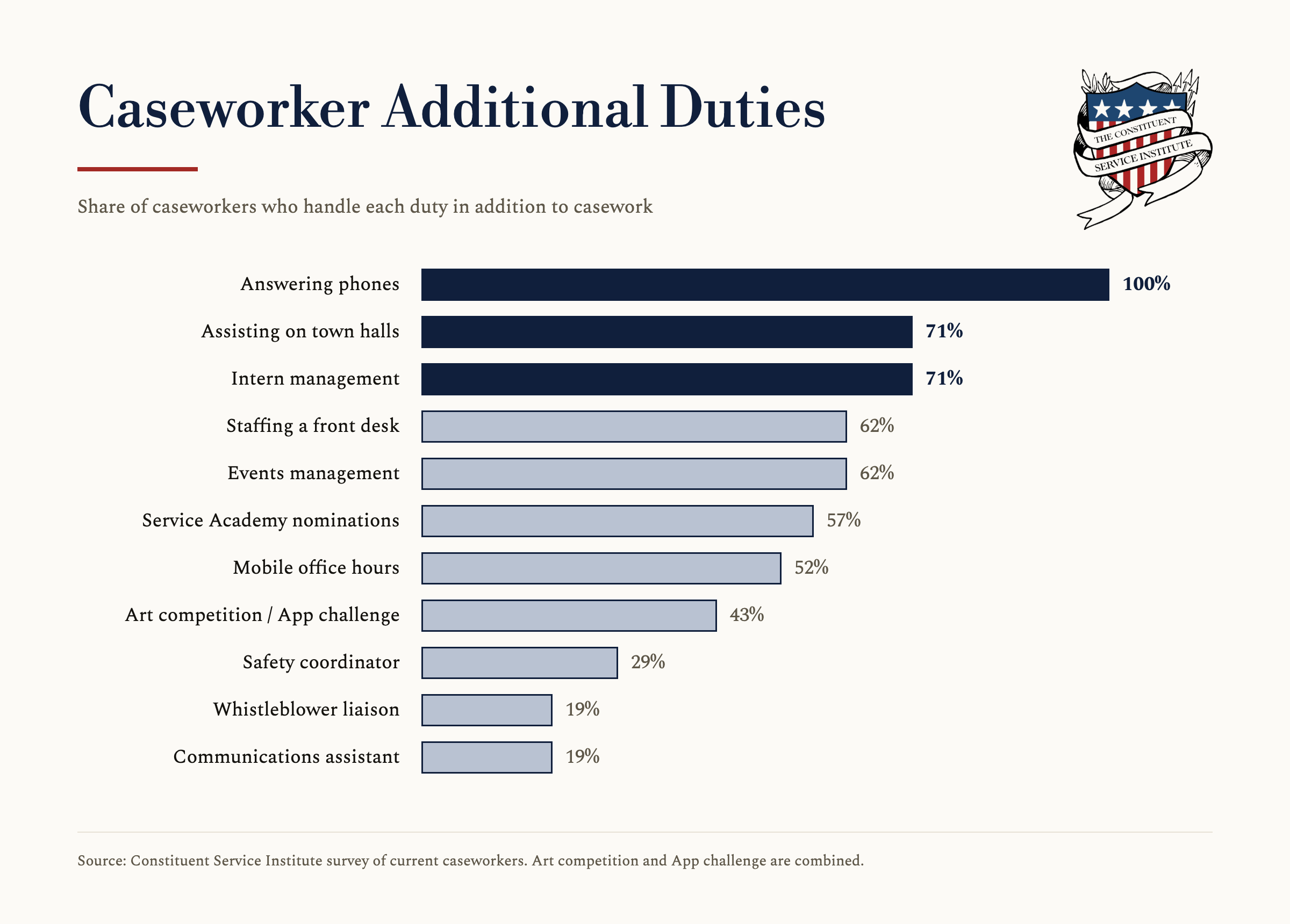
Over time, caseworkers often become the keepers of your office's institutional knowledge and long-term relationships — with agency liaisons, local partners, and the community. According to HillClimbers House data, the average House constituent services representative or caseworker has 4.4 years of House or Member-office experience; the average House casework manager has 8.3.
That value doesn't end when they leave. Casework alumni go on to a wide range of fields, where they remain ambassadors for your office and useful relationships for advancing your priorities.
What should I look for in the hiring process?
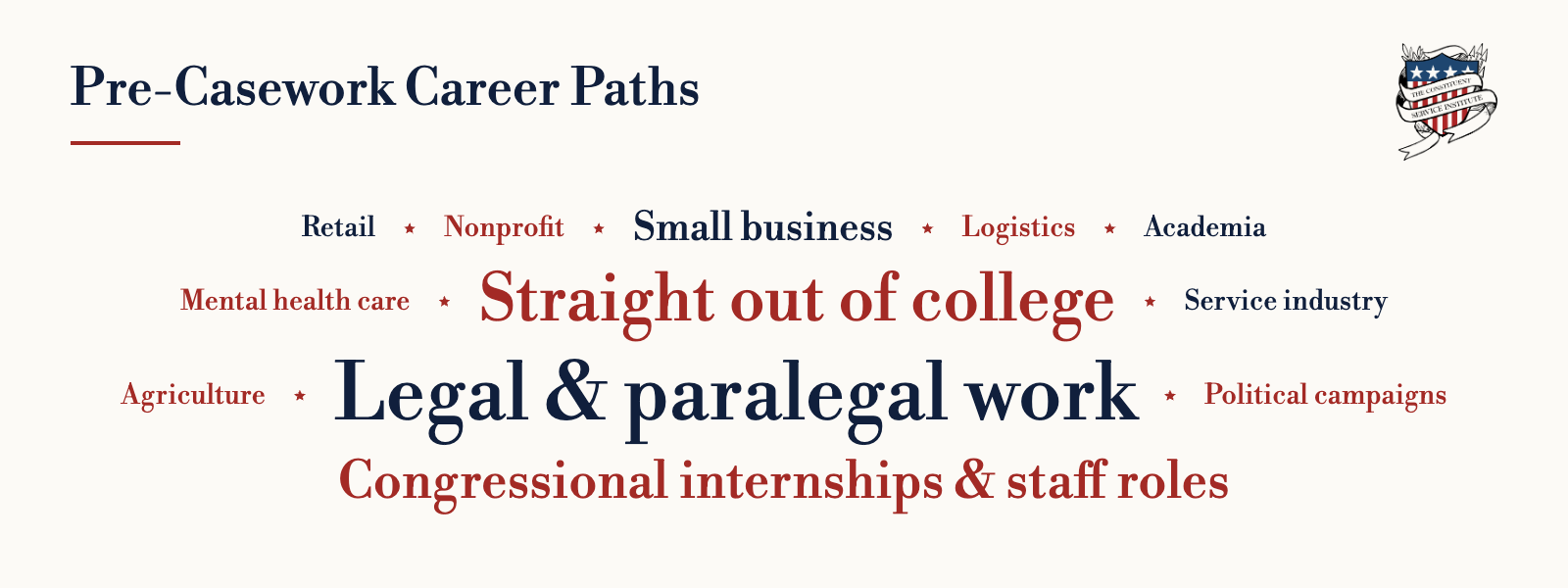
Caseworkers serving today come from a wide range of backgrounds — from fresh-out-college interns to experienced caseworkers who have served with multiple Members to professionals on their second (or third!) career transition.
However, a few backgrounds and skills consistently pay off.
Customer service and working with the public. This is close to non-negotiable. Hospitality, retail, call centers, front desks, nonprofit client services — any job where they've dealt with the public directly, and done it well, is a major green flag.
Previous casework experience. Many caseworkers are glad to stay on through multiple Members, even across parties. If you find a good caseworker from the outgoing office, move them to the top of the pile. They bring experience, agency contacts, and district knowledge, which gives you a strong head start. Still, given the diversity of casework approaches across offices, it is still critical to make sure that incoming caseworkers are enthusiastic about the way your team plans to work. Check references!
Familiarity with your district. A sense for the geography, culture, industries, landmarks, etc., can be very helpful.
Paralegal experience, especially for immigration. Immigration is a complex and technical caseload, and frequently involves liaising with attorneys who are helping their clients navigate the immigration process. Some familiarity with the legal landscape for immigration is helpful, but not a dealbreaker.
Social work. Current or former social workers come with some previous training on managing difficult constituents, safety, benefits programs, and more — and they are increasingly sought out by Congressional offices hiring casework teams.
Previous government experience. Former federal agency staff, former state agency staff, and — of course — experience with constituent service at other levels of government can all be helpful in familiarity with programs, how government works, and specific contacts.
Data maintenance and CRM management. Casework runs on records. Someone comfortable keeping a CRM clean keeps cases from slipping through the cracks and makes it possible to spot trends.
Shared backgrounds for specific portfolios. A veteran handling veterans' casework, for example, is already familiar with common terminology and experiences. This helps, but it isn't necessary.
Languages frequently spoken in your district. While translation services are available if necessary, having someone on staff fluent in languages commonly spoken in your district or state can be a major advantage in a fast-moving case.
Hiring your casework manager
A good casework manager is worth their weight in gold — and it’s worth some early work to determine your salary bands and headcount to attract and retain a good one. More on that below!
In general, we strongly endorse designating a single staff member as a Casework Manager or Director of Constituent Services, reporting to the District or State Director or directly to the Chief of Staff — especially in Senate offices or high-volume House offices.
The Casework Manager models and enforces the culture of responsiveness and care that distinguishes a great casework operation. In addition to maintaining a casework portfolio themselves, they maintain the overall accuracy and completeness of your team’s CRM, provide experience and judgement on difficult cases, liaise with other teams within the office to make sure casework is integrated into the rest of the office’s operations, handle casework-related projects like mobile office hours and proactive casework, and take responsibility for training new casework staff. Having a senior caseworker and/or a casework director also creates a strong professional development pipeline within your office, giving casework staff clear goals if they want to take on additional responsibility.
We’d also recommend hiring your Casework Manager first if possible so that they can play a role in hiring the rest of your team.
Template Casework Job Postings
These sample job postings assume that caseworkers in your office are primarily dedicated to casework — not handling outreach and field duties — but still responsible for developing relationships with some local stakeholders who may be important for casework referrals and relationships, like local elected officials. Just like titles, there are many different models for establishing a casework team, so use these template job descriptions as a starting point for the specific combinations of roles and responsibilities you’re hiring for.
-
See above for alternate titles.
Job title: Director of Constituent Services
Office: Office of [Rep./Sen. Full Name] [Party, State or District], [district or state office]
Location: [City, State] · [In person / Hybrid] · [Occasional travel within the district or state]
Employment type: Full-time
Reports to: [District Director / State Director / Chief of Staff]
Salary: $[X]–$[Y] per year, plus benefits. House Casework directors earn on average $86,245 per year (HillClimbers data), and Senate Casework Directors earn $102,936 per year (CRS data).
Apply by: [Date, or "Applications reviewed on a rolling basis"]
About the role
Our casework team helps hundreds of people in [District or State] with problems with the federal government that they can't solve on their own. As Director of Constituent Services, you'll lead that team: setting standards, building a team that's skilled and resilient, keeping cases moving, turning what caseworkers learn into input for policy and oversight, and helping tell the story of our office’s work. You'll also be the office's go-to person for the most complex and sensitive cases, and a keeper of its long-term agency and community relationships.
What you'll do
Lead and manage a team of caseworkers [and interns]: assign portfolios, balance caseloads, and review casework quality.
Hire, train, and coach caseworkers, and build a culture of follow-through, care, and healthy boundaries.
Set and document casework policies, workflows, contacts, and best practices, so the team builds a consistent constituent experience.
Manage the office's case management system and data: keep records clean, track trends, and report on caseload and outcomes.
Handle the most complex, urgent, and sensitive cases, and step in when a case is stuck.
Build and maintain relationships with agency congressional liaisons, state and local partners, and community organizations.
Work with the legislative and communications teams to turn casework trends into policy and oversight priorities and effective storytelling.
Plan constituent services outreach, such as mobile office hours, and represent the office at community events in a professional, nonpartisan way.
What you'll bring
[Several] years of casework or comparable direct-service experience, such as legal services, social services, or customer service leadership.
Experience supervising, training, or mentoring others.
Strong organization and the ability to manage many priorities at once.
Sound judgment and discretion with sensitive personal information.
Creative problem-solving, especially on cases with no clear path.
Comfort with data and reporting, and clear writing.
Steadiness under pressure, and the ability to help a team stay resilient through hard cases.
Nice to have
Congressional or state legislative casework experience.
Experience administering a CRM or case management system.
Existing relationships with federal agency liaisons or community organizations in [District or State].
Fluency in a language spoken in [District or State].
Schedule: Monday through Friday, with occasional evenings and weekends for events.
Benefits: [Federal benefits including health insurance and TSP; student loan repayment; paid leave. Confirm with your office.]
How to apply: Send your resume and a short cover letter as one PDF to [email address], with "Director of Constituent Services — [Your Name]" in the subject line.
Don't meet every qualification? We still encourage you to apply.
Accommodations: If you need an accommodation to apply or interview, contact [name, email, and phone].
Equal opportunity: [Your office's nondiscrimination statement.]
-
See above for alternate titles, including Constituent Services Representative or Constituent Advocate.
Office: Office of [Rep./Sen. Full Name] [Party, State or District], [district or state office]
Location: [City, State] · [In person / Hybrid]
Employment type: Full-time
Salary: $[X]–$[Y] per year, plus benefits. Non-management casework salaries average $65,198 in the House, per HillClimbers data, and $66,289 in the Senate.
Apply by: [Date, or "Applications reviewed on a rolling basis"]
About the role
When people in [District or State] hit a wall with a federal agency — a stalled VA claim, a missing tax refund, a passport they need for travel next week — they call our office. As a caseworker, you'll be the person who picks up, works the problem with the agency, and sees it through. You'll also help spot patterns in cases so our team can push for lasting fixes.
Prior casework experience is welcome but not necessary. We're looking for someone organized, patient, and creative who wants to help people.
What you'll do
Help constituents resolve problems with federal agencies, such as the Social Security Administration, the Department of Veterans Affairs, the IRS, and the State Department.
Manage a large caseload, keep records current in the office's case management system, and give constituents regular, honest updates.
Write clear inquiries to agencies and letters to constituents.
Build relationships with agency congressional liaisons, community stakeholders and service organizations, and state and local elected leaders and staff.
Connect people with state, local, and community resources when an issue isn't federal.
Flag recurring problems and trends to the legislative team.
Help with phones, the front desk, office events, mobile office hours, town halls, and intern management as needed.
Represent the office at community events.
What you'll bring
Experience working directly with the public, whether in customer service, hospitality, retail, social services, legal aid, or another setting.
Strong organization and follow-through.
Clear writing and careful attention to detail.
Patience, good judgment, and discretion with sensitive personal information.
Creativity in solving problems that don't have an obvious answer.
Comfort with computers and willingness to learn a case management system.
Nice to have
Casework, paralegal, or social work experience.
Experience with a CRM or database.
Fluency in a language spoken in [District or State], especially [language].
Familiarity with [District or State]: its communities, geography, and local organizations.
Schedule: Monday through Friday, with occasional evenings and weekends for events.
Benefits: [Federal benefits including health insurance and TSP; student loan repayment; paid leave. Confirm with your office.]
How to apply: Send your resume and a short cover letter as one PDF to [email address], with "Caseworker — [Your Name]" in the subject line.
Don't meet every qualification? We still encourage you to apply. Many great caseworkers come from other fields.
Accommodations: If you need an accommodation to apply or interview, contact [name, email, and phone].
Equal opportunity: [Your office's nondiscrimination statement.]
-
See above for alternate titles.
Office: Office of [Rep./Sen. Full Name] [Party, State or District], [district or state office]
Location: [City, State] · [In person / Hybrid]
Employment type: Full-time
Salary: $[X]–$[Y] per year, plus benefits. Non-management casework salaries average $65,198 in the House, per HillClimbers data, and $66,289 in the Senate.
Apply by: [Date, or "Applications reviewed on a rolling basis"]
About the role:
Veterans, service members, and military families in [District or State] count on our office when a disability claim stalls, a pension payment stops, or a service record goes missing. As our veterans and military caseworker, you'll take those cases from first call to resolution, build working relationships with the VA and the military services, and stay connected to the veterans community across [District or State].
Military service or a military family background is a plus, but it isn't required. We're looking for someone who can earn trust, stay organized across long and complex cases, and keep going until the problem is solved.
What you'll do
Help veterans, service members, and families resolve problems with the Department of Veterans Affairs (benefits, claims, and health care), the Department of Defense, the military branches, and related agencies such as military pay and records offices.
Manage a portfolio of cases, keep records current in the office's case management system, and give constituents regular, honest updates.
Build relationships with agency congressional liaisons, veterans service organizations, county and state veterans services, and local military installations.
Connect constituents with state, local, and community resources, from housing and employment help to mental health support.
Do outreach with veterans groups and attend community events in a professional way.
Track recurring problems and brief the legislative team on trends.
[Coordinate military service academy nominations, if part of this role.]
What you'll bring
Experience working directly with the public, in any setting.
Strong organization and follow-through on cases that can take months.
Clear writing and careful attention to detail.
Discretion with sensitive health, financial, and service records.
Willingness to learn military and VA terms, structures, and processes.
Nice to have
Military service, or experience as a military spouse or family member.
Experience with a veterans service organization, a county veterans service office, or VA-related work.
Casework, paralegal, or social work experience.
Ties to the military and veterans community in [District or State].
Schedule: Monday through Friday, with occasional evenings and weekends for events.
Benefits: [Federal benefits including health insurance and TSP; student loan repayment; paid leave. Confirm with your office.]
How to apply: Send your resume and a short cover letter as one PDF to [email address], with "Veterans Caseworker — [Your Name]" in the subject line.
Don't meet every qualification? We still encourage you to apply.
Accommodations: If you need an accommodation to apply or interview, contact [name, email, and phone].
Equal opportunity: [Your office's nondiscrimination statement.]
-
See above for alternate titles.
Office: Office of [Rep./Sen. Full Name] [Party, State or District], [district or state office]
Location: [City, State] · [In person / Hybrid]
Employment type: Full-time
Salary: $[X]–$[Y] per year, plus benefits. Non-management casework salaries average $65,198 in the House, per HillClimbers data, and $66,289 in the Senate.
Apply by: [Date, or "Applications reviewed on a rolling basis"]
About the role:
Families in [District or State] turn to our office when an immigration application stalls, a visa interview is delayed, or a loved one's paperwork gets lost in the system. As our immigration caseworker, you'll help constituents navigate federal immigration agencies, explain what our office can and can't do, and make sure every person who calls is treated with patience and respect.
This role is a good fit for someone with experience in immigration legal services, community organizations, or direct service with immigrant communities. You don't need to be an attorney; congressional offices don't give legal advice, and you'll refer constituents to qualified legal help when they need it.
What you'll do
Help constituents with delayed or stuck applications, petitions, and visas before U.S. Citizenship and Immigration Services, other Department of Homeland Security components, and the State Department.
Gather the right documentation, submit inquiries, and request expedited processing when a case meets the agency's criteria.
Manage a high-volume caseload, keep records current in the office's case management system, and give constituents regular, honest updates.
Explain processes and timelines in plain language, and set clear expectations about what the office can do.
Refer constituents to legal service providers and community organizations when they need help the office can't give.
Build relationships with agency congressional liaisons and immigrant-serving community groups.
Track recurring problems and brief the legislative team on trends.
What you'll bring
Experience working directly with the public, ideally with immigrant communities.
Strong organization and attention to detail; immigration cases depend on getting forms, dates, and receipt numbers exactly right.
Patience, cultural competency, and respect for people in stressful situations.
Discretion with sensitive personal information.
Clear writing and the ability to explain complex processes simply.
Nice to have
Immigration paralegal or legal services experience.
Fluency in [language(s) spoken in your district or state].
Federal casework experience, especially immigration.
Familiarity with immigration forms and procedures.
Ties to [District or State] and its immigrant communities.
Schedule: Monday through Friday, with occasional evenings and weekends for events.
Benefits: [Federal benefits including health insurance and TSP; student loan repayment; paid leave. Confirm with your office.]
How to apply: Send your resume and a short cover letter as one PDF to [email address], with "Immigration Caseworker — [Your Name]" in the subject line.
Don't meet every qualification? We still encourage you to apply.
Accommodations: If you need an accommodation to apply or interview, contact [name, email, and phone].
Equal opportunity: [Your office's nondiscrimination statement.]
Where should I post our casework jobs?
House: The House Vacancy Announcement and Placement Service (HVAPS), run by the Chief Administrative Officer, offers three tools: the House Resume Bank, the weekly House Employment Bulletin, and the House Talent Marketplace career site (House.gov). The Resume Bank has a general Caseworker listing, so you can request resumes from people who have already said they're interested, whether or not you've posted the job (House Resume Bank).
Senate: The Senate Employment Office publishes the Senate Employment Bulletin and keeps a resume bank it shares with Senate offices on request (Senate Employment Office on Handshake). It encourages state office applicants to apply where they have strong state or regional ties (Senate Employment Office).
Party resume banks: House Democrats keep a resume bank and job announcements board (House Democratic Whip), and House Republican leadership manages House GOP Jobs (Committee on House Administration).
Public service and nonprofit boards, such as Idealist or ConservativeJobs.
Colleges and universities in your district or state, including career centers and programs in social work, public policy, and legal studies.
Community partners tied to the portfolio: veterans service organizations and county veterans services for a veterans caseworker; immigrant-serving groups and legal aid organizations for an immigration caseworker; senior centers and Area Agencies on Aging for an aging portfolio.
Send it to us! We share job postings and news about casework in our regular newsletter for caseworkers. info@constituentserviceinstitute.org.
Interview Questions for Caseworkers
As a transition aide or a new District or State Director, it can be tough to figure out how to interview candidates for a job you are not directly familiar with. The questions below are intended to be a starting point to help you structure candidate interviews to evaluate specific casework skills, character traits, professional experience, and judgement that contribute to a well-rounded caseworker. Each question includes some notes on the specific skills it’s looking for, and a suggested follow up question to dig deeper (scroll right if you’re reading on mobile). We’ve also included hypothetical casework scenario questions to measure how someone approaches a difficult problem, whether they have direct casework experience or not.
Portfolio-Specific Scenarios
These scenarios help hiring managers on transition teams test caseworker candidates against real-world cases. They show how a candidate thinks on their feet and what instincts they bring to a difficult case. For each scenario, we've included notes on what you might hear from an experienced caseworker and from a candidate without casework experience, so your team has a starting point for what to listen for.
Select any rows and paste them into your interview notes.
| Portfolio | Scenario | What it's getting at | Listen for: with casework experience | Listen for: without casework experience |
|---|---|---|---|---|
| Aging and senior constituents | An older constituent calls for the third time this week about the same Medicare issue and seems unsure what you discussed last time. How do you handle it? | Patience; clear communication; knowing when to involve a caregiver or authorized representative; creativity in problem-solving | Confirms who can speak for the constituent and gets a privacy release; keeps notes so each call picks up where the last left off; sends a written recap or loops in a caregiver; knows community resources, like the local Area Agency on Aging, that could offer support. | Stays patient and warm on the third call; summarizes clearly and checks for understanding; thinks to send a written recap and to ask whether a family member or caregiver could help. |
| Immigrant constituents | A constituent with limited English calls about a family member's visa application that has been pending for more than a year. Where do you start? | Language access; cultural competency; setting honest expectations about what the office can do | Gets a Privacy Act release form that meets USCIS requirements, signed by the right person (which may not be the relative who called); checks the case status and USCIS processing times; arranges interpretation or a staffer who speaks the language; explains honestly what the office can and can't do. | Finds a way to communicate, like an interpreter or translated materials; asks clarifying questions about the application; is honest that some timelines are out of the office's hands. |
| Immigrant constituents | A constituent filed an I-129F petition for her fiancé, who lives abroad, eight months ago. She was just diagnosed with a serious illness and is starting treatment. She says no one else can help care for her, and she asks your office to request that USCIS expedite the petition. What do you do? Harder variation: make the reason weaker, like a lingering cough, and listen for whether the candidate can explain kindly why it likely won't qualify and what they can still do. | Judgment about urgent requests; gathering the right documentation; setting honest expectations | Knows USCIS decides expedites case by case, at its discretion, against set criteria such as urgent humanitarian reasons. Gets a signed privacy release, asks for documentation like a doctor's letter, and checks whether the case is outside normal processing times. Explains that an approved expedite isn't an approved petition, and that the fiancé still needs a K-1 visa from the State Department. | Says they'd look up USCIS's criteria for expediting to see whether her situation might qualify, thinks about what documentation would support the request, and looks for other ways to help in the meantime, like local caregiving or support services. |
| Veteran constituents | A veteran tells you he's been fighting the VA for years and doesn't trust anyone anymore — including you. What do you say? | Trust-building; familiarity with VA structure and veterans service organizations | Acknowledges the frustration without overpromising; knows the VA's structure and when to bring in a veterans service organization; sets a clear next step and follows through. | Listens before jumping to solutions; doesn't get defensive; offers one concrete next step and a time they'll call back. |
| Veteran constituents | A constituent calls your office. Her husband, a veteran, stopped receiving his VA disability payments two months ago. They've called the VA hotline four times and gotten a different answer each time. Their mortgage payment is due in ten days. | Approaching a new problem; gathering information; thinking about short-term needs | Gets a signed privacy release before contacting the VA; asks for the award letter and recent VA correspondence; can tell you which part of the VA to go to (for disability payments, the Veterans Benefits Administration, usually through the regional office's congressional liaison); sets expectations about timing and points the family to short-term help with the mortgage. | Asks whether the family has records of when they called, what they heard, and who they spoke to; whether there's other VA documentation about what type of benefit he receives; and whether short-term resources could help with the mortgage while the problem gets sorted out. |
| Homeless constituents | A constituent experiencing homelessness needs a replacement Social Security card but has no ID and no mailing address. Where do you begin? | Resourcefulness; knowledge of local services; flexibility in how to stay in contact | Knows what identity documents SSA may accept and which local agencies or shelters can help; sets up another way to stay in contact, like a shelter address or a case manager's phone. | Thinks creatively about how to stay in touch; asks what documents or records the constituent does have; thinks of local organizations that might help. |
General Casework Interview Questions
Each question notes what it's getting at and a follow-up to push past the rehearsed answer.
Select any rows and paste them into your interview notes.
| # | Question | What it's getting at | Follow-up |
|---|---|---|---|
| 1 | Why do you want to work for this Member, in this district? | Dedication to doing this job | What do you already know about the communities here? |
| 2 | In your own words, what is constituent service work? What matters most in doing it well? | Understanding of the role; priorities and values | If you did this job well, what would a constituent say about you and the Member? What would they say if you did it badly? |
| 3 | Based on what you know of this district, what do you think the top categories of casework requests might be? | Active casework skills; thinking on your feet | Where do you think our team would make the most referrals to local social services or nonprofits? |
| 5 | Tell me about something you wrote or submitted that had to be exactly right. How did you fact-check and proofread it before it went out? | Conscientiousness; attention to detail | What's a mistake you caught, or missed? What did you do differently afterward? |
| 6 | Have you used a CRM or database? Tell me about a time you had to keep detailed records. | Conscientiousness; attention to detail | If you were out sick for a week, could someone else pick up where you left off? |
| 7 | Tell me about a time when you've screwed up in a professional setting. What went wrong, and what did you do next? | Resilience, conscientiousness | When in that process did you let someone else know what was going wrong? What did you learn? |
| 8 | Tell me about a time you had to give someone bad news in a professional setting. | Working with people | How often do you think about that moment? How do you pull yourself out if that answer is a lot? |
| 9 | Tell me about a week when your priorities and responsibilities changed suddenly. How did you decide what to drop and what to keep going? | Personal organization; multitasking | How did you let people waiting on you know about the change? |
| 10 | There's no sugarcoating the fact that this job is hard, and there will be really difficult cases and really difficult days. What's your “why” for doing political work? What draws you to working for Congress? | Resilience | What would threaten that why, or change your calculus about whether this job is a good fit for you? |
| 11 | You have a magic wand to fix one thing in government. What's at the top of your list? | Pattern recognition; identifying opportunities for policy and oversight in casework. | Who would need to act to fix it? How would you make that case to someone who might have a different priority? |
| 12 | Tell me about something you led because you saw an opportunity, not because someone asked you to. How did you get it started, and how did you see it through? | Leadership; initiative; self-motivated follow-through | What got in the way, and how did you keep it moving? |
| 13 | There will be times you disagree with a stance the Member takes or a vote they cast. How would you handle that? | Professionalism; serving every constituent regardless of politics; raising disagreement through the right channels | What if a constituent calls, upset about that same vote, and needs help with a case? |
| 14 | Casework can be a launchpad to lots of different careers. Where do you see yourself going in 5 or 10 years? | Dedication to doing this job | What would you want to learn in this role to get there? |
Manager Interview Questions
These questions are for candidates for casework manager or Director of Constituent Services roles. Use them alongside the general interview questions. They focus on how a candidate leads people, balances their own work with the team's, and builds a team that can grow.
Select any rows and paste them into your interview notes.
| # | Question | What it's getting at | Follow-up |
|---|---|---|---|
| 1 | Tell me about the best manager you've ever had. What did they do that you've tried to carry into your own management? | Management philosophy; self-awareness | Walk me through what a typical week looks like for you as a manager: check-ins, reviews, how you stay connected to your team. |
| 2 | Tell me about a time you needed to have a difficult conversation with someone who reported to you. How did you approach it? | Giving direct, fair feedback; accountability; care for the team | What happened afterward? Would you handle it differently now? |
| 3 | Tell me about a time you needed to have a difficult conversation with your own manager. How did you approach it? | Managing up; advocating for the team; professionalism | How did you decide it was worth raising? What came of it? |
| 4 | As a manager, how have you split your time and focus between your own work and managing your team's work? | Prioritization; delegation; knowing when to step in | Tell me about a time that balance went wrong. What did you change? |
| 5 | How do you approach training? What experience do you have training others? | Training and onboarding; building the team's knowledge | How would you know when a new team member is ready to handle cases on their own? |
| 6 | Casework can wear people down. How have you supported a team member who was struggling with the weight of the work? | Team resilience; boundaries; care for staff | How do you look after your own resilience? |
| 7 | Tell me about a time when you've used data and evidence in your management. | Building an argument from evidence; persuasion; analytical thinking | You're a casework manager and you're recognizing that your team is over capacity. What evidence would you draw on to make the case for more headcount to your Chief of Staff? |
How can we help?
We think your caseworkers are going to be some of your favorite hires. Got a question or a resource you’d like to see here? Come chat! And for caseworkers looking to GET hired, see our Job Hunting for Caseworkers Guide.